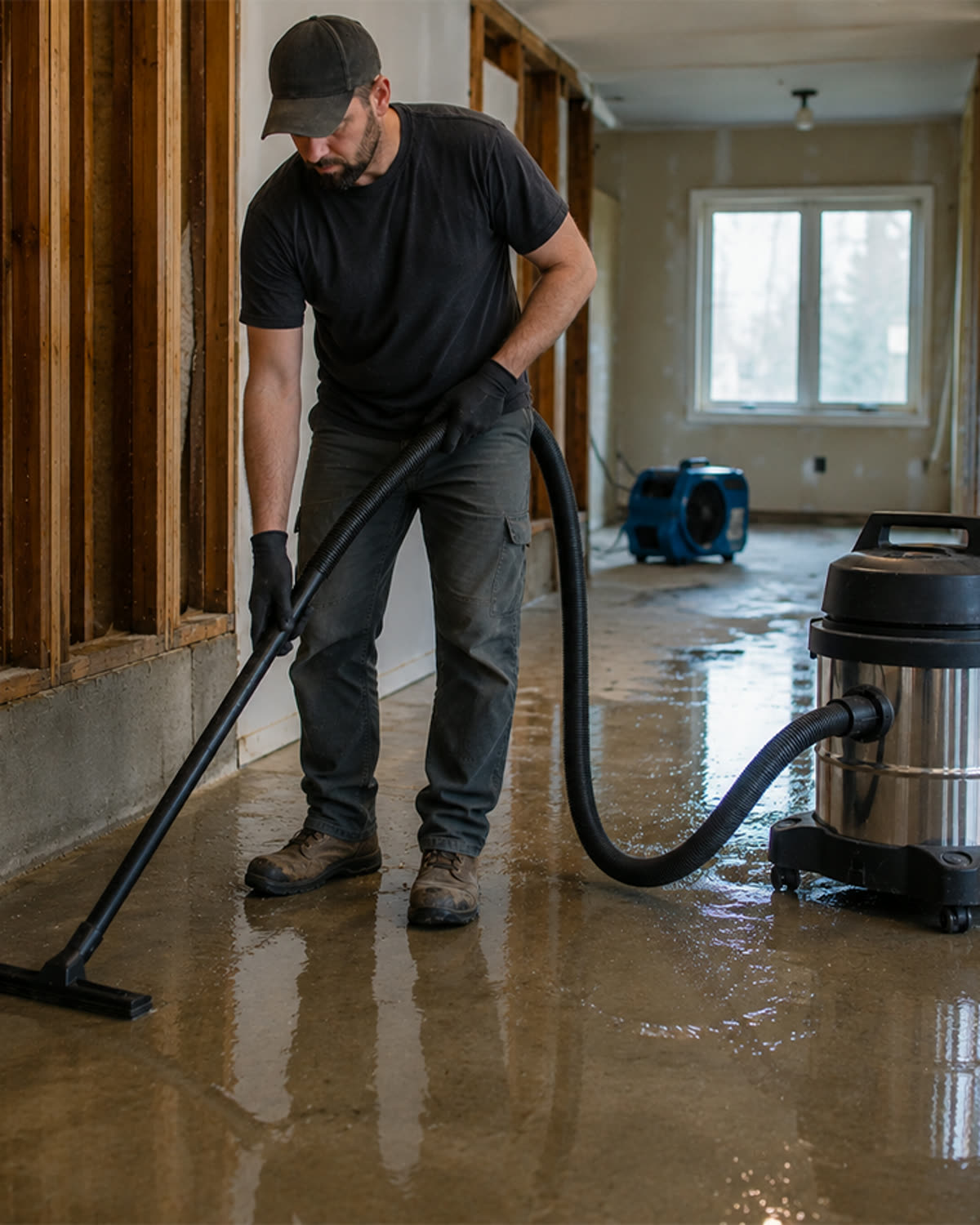
A vacuum may run normally while leaving a visible layer of dust behind.
This can happen because:
- Airflow is weak
- The attachment is poorly matched
- Dust is stuck to the surface
- The hose is restricted
- The filter or bag is clogged
- Fine dust escapes around the nozzle
- Exhaust air redistributes dust
- Static holds particles in place
The solution is not always a more powerful vacuum.
The complete capture system must bring moving air close enough to the dust to lift and transport it.
Quick Answer
A shop vacuum may leave dust behind because of:
- Clogged filter
- Loaded bag
- Hose restriction
- Air leak
- Floor nozzle too wide
- Nozzle held too far from surface
- Static adhesion
- Embedded dust
- Dust blowing from exhaust
- Fast cleaning passes
- Inappropriate brush or squeegee
- Fine dust smaller than the collection system can handle
Test the vacuum from the inlet outward and use an attachment matched to the surface and material.
The Capture-Zone Principle™
Dust must enter the moving-air zone around the nozzle.
Strong Airflow at Motor

Does Not Guarantee

Strong Airflow at Dust
Distance, attachment shape, leaks, and surface contact determine the actual capture zone.
Cause 1: Weak Working Airflow
Working airflow may be reduced by:
- Loaded bag
- Clogged filter
- Blocked hose
- Narrow adapter
- Closed float
- Excessive hose length
Test the system one stage at a time.
Cause 2: Air Leak
Air entering through:
- Lid seal
- Drain
- Hose cuff
- Bag collar
- Separator lid
- Accessory port
does not contribute to pickup at the nozzle.
Motor Airflow

−

Leakage

=

Useful Nozzle Airflow
Cause 3: Floor Nozzle Is Too Wide
A wide nozzle spreads available airflow across a larger opening.
If the vacuum cannot supply enough air, pickup becomes weak across the tool.
A narrower nozzle may improve local capture.
Cause 4: Nozzle Is Sealed Incorrectly
A nozzle needs controlled air entry.
If it seals completely to the floor:
- Airflow stops
- Dust does not move
- Tool becomes difficult to push
If it sits too far above the floor:
- Airflow spreads
- Fine dust remains outside the capture zone
The correct nozzle maintains a narrow, controlled opening.
Cause 5: Dust Is Embedded
Dust may be held inside:
- Carpet fibers
- Concrete pores
- Wood grain
- Grout lines
- Textured flooring
- Upholstery
Mechanical agitation may be needed.
Use:
- Brush tool
- Carpet tool
- Soft agitation
- Multiple directions
- Surface-appropriate methods
Cause 6: Static Adhesion
Fine dry particles may cling to:
- Plastic
- Vinyl
- Hose walls
- Smooth flooring
- Equipment
Vacuum airflow may not overcome the static attraction immediately.
Anti-static tools, grounding systems, or compatible wiping methods may help in appropriate applications.
Cause 7: Dust Is Too Fine and Light
Drywall and concrete dust can be disturbed by the approaching nozzle.
Instead of entering the tool, particles may:
- Move sideways
- Become airborne
- Settle behind the operator
Use slower passes and a nozzle designed to contain the airflow.
The Dust-Push Effect™
Nozzle Approaches Quickly

↓

Turbulent Air Pushes Fine Dust

↓

Dust Moves Outside Capture Zone

↓

Visible Layer Remains
Slower controlled movement improves pickup.
Cause 8: Exhaust Air Is Redistributing Dust
The exhaust may blow across:
- Floor
- Workbench
- Plastic sheeting
- Dust pile
Even clean exhaust can move loose particles.
Redirect exhaust away from the cleaning area when the vacuum design permits.
If exhaust contains dust, inspect the filter and seals immediately.
Cause 9: Wrong Attachment
Fine Floor Dust
Use:
- Brush-edged floor tool
- Narrow controlled opening
- Suitable fine-dust nozzle
Large Debris
Use:
- Larger open nozzle
- Large hose
Water
Use:
- Squeegee tool
Carpet
Use:
- Agitation-capable carpet tool
One tool cannot perform every job equally well.
Cause 10: Passes Are Too Fast
The dust needs time to:
- Release from the surface
- Enter the air stream
- Travel through the attachment
- Enter the hose
Fast passes may collect larger debris while leaving fine material behind.
Cause 11: Attachment Is Clogged
A floor nozzle may contain:
- Hair
- Tape
- Plastic
- String
- Dried mud
- Wood splinters
A partial blockage may be hidden.
Cause 12: Filter or Bag Is Incorrect
A system may leave dust because:
- Suction falls rapidly
- Fine dust passes through
- Exhaust redistributes particles
- Bag blocks the inlet
Use a collection and filtration system matched to the dust.
Dust-Left-Behind Diagnostic Table
| Symptom | Likely Cause |
|---|---|
| Dust remains evenly | Weak airflow or fast passes |
| Dust moves ahead of nozzle | Turbulence or wrong tool |
| Dust remains in texture | Needs agitation |
| Dust reappears behind vacuum | Exhaust redistribution |
| Large debris collected, fine layer remains | Particle size or attachment issue |
| Pickup improves with hose only | Floor nozzle restriction |
| Pickup weak everywhere | Bag, filter, hose, or motor |
| Dust sticks to plastic | Static adhesion |
Diagnostic Sequence
- Test airflow at vacuum inlet.
- Add hose.
- Add attachment.
- Inspect bag.
- Inspect filter.
- Check for leaks.
- Slow cleaning speed.
- Try a narrower or brush attachment.
- Redirect exhaust.
- Evaluate the surface.
Cleaning Technique for Fine Dust
- Work from cleaner areas toward heavier dust.
- Use overlapping passes.
- Move slowly.
- Keep the nozzle flat.
- Avoid dropping the tool into dust piles.
- Use edge tools around walls.
- Inspect under angled lighting.
- Repeat after airborne dust settles when necessary.
The Two-Pass Fine-Dust Method™
First Pass
Collect:
- Larger debris
- Heavy dust
- Fragments
Second Pass
Use:
- Cleaner attachment
- Slower movement
- Fine-dust configuration
- Edge and detail tools
This prevents large debris from interfering with final fine-dust pickup.
Dust Pickup Checklist
- Bag below airflow capacity
- Filter clean enough
- Hose clear
- Attachment clear
- Lid sealed
- Drain sealed
- Nozzle matched to surface
- Exhaust directed away
- Cleaning speed controlled
- Static considered
- Embedded dust agitated
- Fine-dust filtration installed
Common Mistakes
Buying a Wider Nozzle
A wider opening may weaken the capture zone.
Moving Faster to Finish Sooner
Fine particles need adequate contact time.
Ignoring Exhaust Direction
The vacuum may redistribute dust.
Using a Hard Floor Tool on Carpet
Embedded particles remain.
Using a Crevice Tool for Large Areas
Cleaning becomes slow and uneven.
Assuming Visible Suction Means Adequate Airflow
The hose may pull strongly while total airflow remains low.
Frequently Asked Questions
Why does the vacuum collect crumbs but leave fine dust?
Fine particles may require better filtration, slower passes, and a more controlled nozzle opening.
Why does dust move away from the nozzle?
Turbulent air may be pushing it outside the capture zone.
Why does dust remain in concrete pores?
Mechanical agitation may be necessary to release embedded particles.
Can exhaust air move dust?
Yes. Redirect it away from the cleaning area when possible.
Will a stronger vacuum solve the problem?
Not necessarily. Attachment design, leaks, filtration, and technique may be more important.
Why does pickup improve when I remove the floor tool?
The attachment may be blocked or too restrictive.
Key Takeaways
A shop vacuum leaves dust behind when the capture zone does not reach the material effectively.
Correct:
- Airflow
- Leaks
- Attachments
- Cleaning speed
- Surface agitation
- Exhaust direction
The vacuum does not clean merely because the motor is running. Dust must be released from the surface and carried into a controlled airflow path.