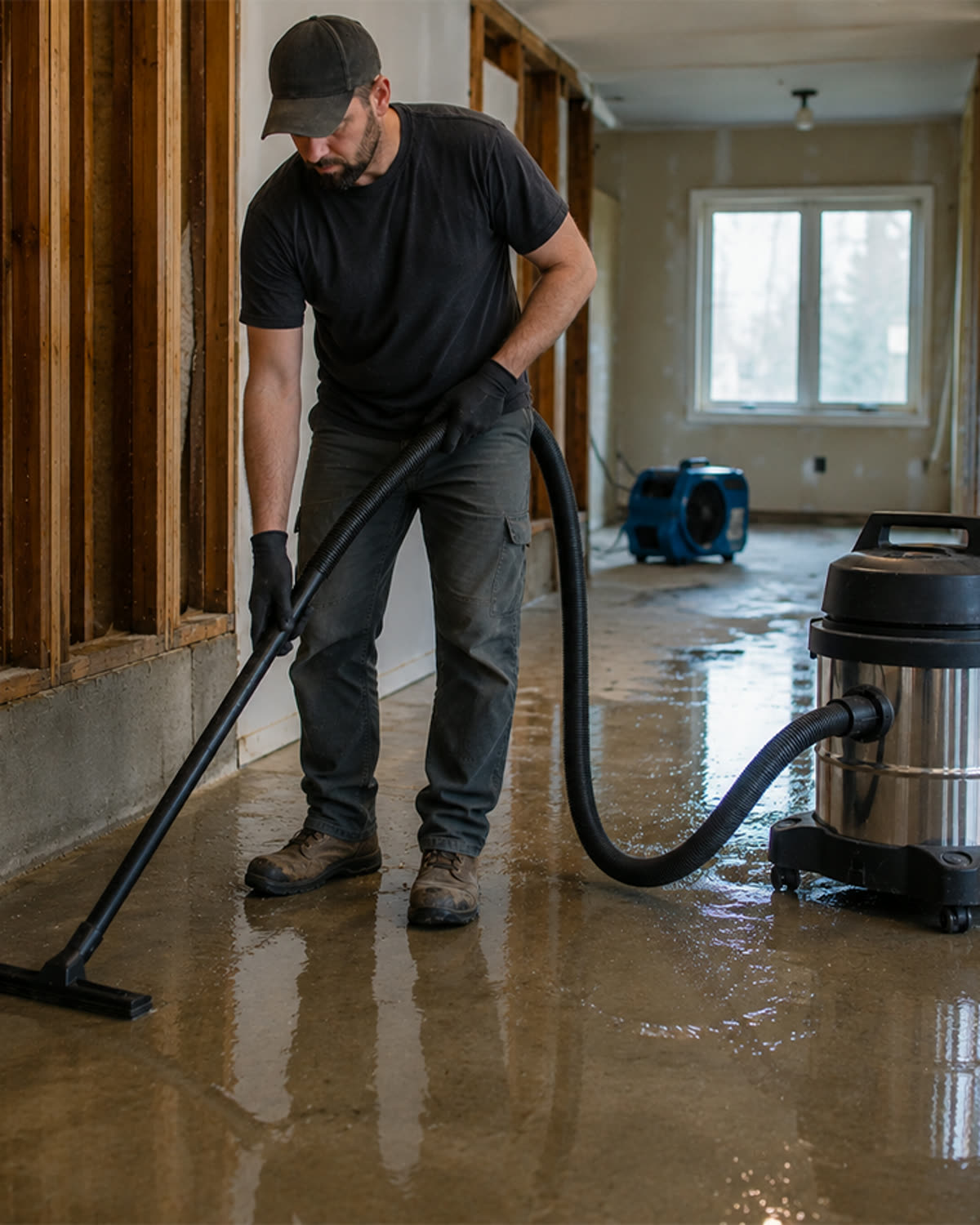
Shop vacuum packaging is covered with numbers.
Peak horsepower.
CFM.
Water lift.
Air watts.
Tank capacity.
Amps.
Filter efficiency.
Each number sounds important.
But which one actually tells you whether the vacuum will pick up drywall dust, pull debris through a long hose, or keep up with a power tool?
The answer is not one number.
Vacuum performance depends on how several measurements work together.
A vacuum can have impressive suction pressure but move too little air.
Another may move a large volume of air but struggle against a narrow hose, clogged filter, or restrictive tool port.
And the largest horsepower number on the box may tell you less about real-world cleaning performance than you expect.
To choose the right vacuum, you need to understand what each specification measures—and what it does not.
Quick Answer
The three most common shop vacuum performance specifications measure different things:
- CFM measures how much air the vacuum moves.
- Water lift measures how strongly the vacuum can pull against resistance.
- Horsepower describes motor power, but advertised peak horsepower does not directly measure cleaning performance.
- Air watts attempt to combine airflow and suction into one performance figure.
For general cleanup and fine dust collection, airflow is extremely important.
For pulling heavy debris, overcoming restrictive hoses, or extracting through small tool ports, water lift becomes more important.
The best vacuum balances airflow and suction while maintaining that performance as the filter and collection system load with dust.
Vacuum Performance Is a System
A shop vacuum does not clean because of one impressive number.
It cleans because the motor, fan, hose, filter, collection system, and attachment work together.
Motor and Fan

↓

Create Pressure Difference

↓

Air Enters the Tool

↓

Debris Is Lifted

↓

Airflow Transports Debris

↓

Collection System Removes Material

↓

Filter Cleans Remaining Air

↓

Air Exits the Vacuum
Every stage affects real-world performance.
A high-CFM vacuum can perform poorly with a clogged filter.
A high-water-lift vacuum can feel weak through a leaking hose.
A powerful motor cannot compensate for a collection bag blocking the inlet.
Specifications describe potential performance.
The complete system determines how much of that performance reaches the floor or tool.
🔬 Vacuum Science
A vacuum cleaner does not technically “pull” air into the hose.
Its motor-driven fan lowers the pressure inside the vacuum.
The higher atmospheric pressure outside the machine pushes air toward that lower-pressure area.
The greater the pressure difference, the more strongly air is driven into the system.
But pressure alone is not enough.
Once air begins moving, the vacuum must maintain enough airflow to carry debris through the hose.
This creates the two central forces of vacuum performance:
- Pressure
- Air volume
Water lift represents pressure.
CFM represents air volume.
The Two Forces of Vacuum Performance™
Every shop vacuum relies on two complementary abilities.
Lifting Force
The ability to pull material away from a surface or through resistance.
Measured primarily by water lift.
Transport Force
The ability to keep that material moving through the hose.
Measured primarily by airflow, usually in CFM.
Water Lift

=

Starts the Movement

CFM

=

Keeps the Material Moving
Neither measurement tells the complete story alone.
What Is CFM?
CFM stands for cubic feet per minute.
It measures the volume of air moving through the vacuum system in one minute.
A higher CFM rating generally means the vacuum can transport more air—and potentially more dust and debris—through the hose.
CFM is especially important for:
- Fine airborne dust
- Sawdust
- Drywall dust
- Surface cleanup
- Wide floor tools
- Dust extraction from tools
- Moving lightweight debris
Airflow carries particles after they have been lifted from the surface.
Without sufficient airflow, debris may enter the attachment but settle inside the hose before reaching the tank.
Why CFM Matters for Fine Dust
Fine dust is lightweight.
It does not require enormous lifting force.
But it does require enough moving air to:
- Capture particles near the tool
- Prevent dust from escaping into the room
- Carry particles through the hose
- Move dust into the collection system
- Maintain capture over a wider opening
This is why airflow is often one of the most important measurements for dust collection.
A vacuum may feel strong when you cover the hose with your hand, yet still allow dust to escape around a saw, grinder, or sander if it does not move enough air.
The Dust Capture Zone™
A vacuum attachment creates an area where moving air can capture particles.
Higher Useful Airflow

↓

Larger Capture Zone

↓

More Dust Enters the Tool

↓

Less Dust Escapes
The size of that effective capture zone depends on:
- CFM
- Tool design
- Opening size
- Distance from dust source
- Hose restrictions
- Filter condition
- Air leaks
The vacuum must move enough air at the actual point where dust is generated.
A laboratory CFM number at the machine does not guarantee the same airflow at the end of a long, narrow, bent hose.
What CFM Does Not Tell You
CFM does not tell you how well the vacuum performs against resistance.
A vacuum may move a large amount of air through an open inlet but lose performance when connected to:
- A narrow hose
- A small tool port
- A loaded filter
- A long hose
- Multiple bends
- A restrictive separator
- A nearly full collection bag
CFM is often highest when resistance is low.
Real jobs introduce resistance.
That is where water lift becomes important.
What Is Water Lift?
Water lift measures suction pressure.
It represents how high the vacuum could lift a column of water in a controlled test.
A higher water-lift rating generally indicates that the vacuum can maintain stronger suction against resistance.
Water lift is important when:
- Pulling heavier debris
- Using narrow hoses
- Extracting through small power-tool ports
- Overcoming long hose runs
- Lifting liquid
- Pulling material from cracks
- Working through restrictive filters or accessories
Water lift is sometimes also described as sealed suction or static pressure.
Why Is It Called Water Lift?
Imagine connecting a vacuum to a vertical tube partially filled with water.
The pressure difference created by the vacuum causes the water to rise.
The height of the water column indicates how much static pressure the vacuum can generate.
That height is expressed in inches of water.
This does not mean the vacuum will literally lift debris that many inches.
It is a standardized way of representing pressure.
High Water Lift Does Not Automatically Mean Better Cleaning
Water lift is powerful, but it is only one part of performance.
Imagine two vacuums.
Vacuum A
- High water lift
- Low airflow
Vacuum B
- Moderate water lift
- High airflow
Vacuum A may pull strongly when the hose opening is nearly sealed.
Vacuum B may capture and transport fine dust more effectively across a wider floor tool.
The better choice depends on the job.
The Drinking Straw Comparison™
A narrow drinking straw can create noticeable pulling pressure.
But it cannot move a large volume of air.
A wide tube can move far more air.
But maintaining strong pressure through it requires more power.
Shop vacuum design is a similar balancing act.
Narrow Path

↓

Higher Resistance

↓

Greater Need for Water Lift

Wide Path

↓

Greater Air Volume

↓

Greater Need for CFM
CFM vs. Water Lift
| Performance Factor | CFM | Water Lift |
|---|---|---|
| What it measures | Air volume | Suction pressure |
| Best for | Moving dust and debris | Overcoming resistance |
| Important for fine dust | Very important | Important |
| Important for heavy debris | Important | Very important |
| Important for wide tools | Very important | Moderate |
| Important for narrow tool ports | Important | Very important |
| Affected by clogged filters | Yes | Yes |
| Affected by hose restrictions | Yes | Yes |
| Tells the complete story alone | No | No |
The strongest real-world systems balance both.
What Is Horsepower?
Horsepower is a unit of power.
In theory, it describes how much work a motor can perform.
In shop vacuum advertising, you will often see peak horsepower displayed prominently.
Peak horsepower is not the same as continuous operating horsepower.
It may represent a brief maximum electrical or mechanical output under specific conditions rather than the power continuously available during normal vacuuming.
That makes it difficult to use peak horsepower as a direct comparison between vacuums.
Why Peak Horsepower Can Be Misleading
A larger horsepower label does not guarantee:
- More airflow
- Higher water lift
- Better filtration
- Stronger performance at the hose
- Better fine-dust collection
- Longer motor life
- Lower operating temperature
- Better performance with a loaded filter
Two vacuums with similar peak-horsepower claims may have very different fan designs, hoses, filters, seals, and airflow characteristics.
Horsepower tells you something about the motor.
It does not tell you how efficiently the complete vacuum converts that motor power into usable cleaning performance.
The Horsepower Illusion™
The motor is only the beginning of the performance chain.
Motor Power

↓

Fan Efficiency

↓

Internal Air Path

↓

Filter Resistance

↓

Hose Resistance

↓

Attachment Design

↓

Useful Performance
Every stage can consume part of the motor’s potential.
The number on the motor does not equal the performance reaching the cleaning tool.
What Are Air Watts?
Air watts attempt to combine airflow and suction pressure into one performance measurement.
The concept is useful because it recognizes that moving a large volume of air and maintaining pressure are both important.
However, air-watt figures are not always provided, and testing methods may vary.
Air watts can be helpful when comparing machines tested under similar conditions.
They still do not account for every real-world factor, including:
- Filter loading
- Collection-bag performance
- Hose diameter
- Hose length
- Tool design
- Air leaks
- Dust type
- Maintenance condition
Air watts are more informative than horsepower alone, but they are not a complete substitute for application-specific evaluation.
What Are Amps?
Amps describe electrical current.
A vacuum with a higher amp rating draws more current from the electrical circuit.
This can help you understand:
- Electrical demand
- Circuit requirements
- Extension-cord needs
- Whether other tools can run on the same circuit
Amps do not directly measure suction or airflow.
A vacuum drawing more electricity is not necessarily converting that electricity into better cleaning performance.
Efficiency matters.
What Is Static Pressure?
Static pressure describes a vacuum’s ability to create pressure when airflow is highly restricted or stopped.
Water lift is a common expression of static pressure.
High static pressure helps the vacuum overcome:
- Narrow openings
- Restrictive filters
- Long hoses
- Small tool ports
- Dense debris
Static pressure becomes increasingly important as resistance rises.
What Is Air Velocity?
Air velocity is the speed of air moving through the hose or attachment.
It is influenced by:
- CFM
- Hose diameter
- Attachment opening
- Restrictions
- Pressure
The same amount of airflow moves faster through a smaller opening.
This can improve pickup at a concentrated point.
But narrowing the airflow path also increases resistance.
If the opening becomes too restrictive, total airflow may fall.
The Velocity Balance™
Opening Too Large

↓

Air Speed May Be Too Low

Opening Too Small

↓

Resistance May Be Too High

Correct Opening

↓

Useful Velocity and Airflow
This is why attachment design matters.
A tool that is too wide may spread airflow too thinly.
A tool that is too narrow may choke the system.
How Hose Diameter Changes Performance
Hose diameter has a major effect on vacuum behavior.
Larger-Diameter Hose
Advantages:
- Handles larger debris
- Less likely to clog
- Can move more air
- Lower resistance in many applications
Disadvantages:
- Bulkier
- Less flexible
- May reduce velocity at small pickup points
- May not fit tool ports
Smaller-Diameter Hose
Advantages:
- Easier to handle
- Fits smaller tool ports
- Can create higher air velocity near the opening
- Useful for detail work
Disadvantages:
- Greater resistance
- More likely to clog
- Poorer performance with bulky debris
- May reduce total airflow
The correct hose depends on the job.
How Hose Length Changes Performance
Every additional foot of hose adds friction.
Long hoses provide convenience and reach.
But they also increase resistance.
Performance losses become greater when the hose is:
- Narrow
- Corrugated
- Bent sharply
- Partially clogged
- Crushed
- Connected through multiple adapters
A long, wide hose may outperform a shorter, narrow hose for some cleanup tasks.
There is no universal rule that shorter is always better or smaller always produces more suction.
The complete combination matters.
The Hose Resistance Ladder™
Short, Straight, Wide Hose

↓

Low Resistance

Longer Hose

↓

More Resistance

Narrow Hose

↓

Higher Resistance

Sharp Bends and Adapters

↓

Even Higher Resistance

Partial Clog

↓

Severe Resistance
As resistance rises, the vacuum depends increasingly on its ability to maintain pressure.
Why Filters Change Performance Ratings
Vacuum specifications are often measured with a clean system.
Jobsites are not clean systems.
As the filter loads:
- Resistance rises
- CFM falls
- Motor cooling may decrease
- Pickup slows
- Dust capture may weaken
- Hose clogs become more likely
The best-performing vacuum is not necessarily the one with the highest clean-filter specification.
It may be the one that maintains performance longest as dust accumulates.
The Maintained Performance Principle™
Initial performance gets attention. Maintained performance completes the job.
A vacuum that begins with impressive airflow but loses most of it after several minutes of fine-dust collection may be less productive than one with slightly lower initial numbers and better dust management.
When comparing systems, ask:
- How quickly does the filter load?
- How much airflow remains during use?
- How often must the operator stop?
- Does the collection system protect the filter?
- Does suction recover after cleaning?
- How much dust reaches the final filter?
Clean-Filter Performance vs. Working Performance
Vacuum A

High Initial CFM

↓

Rapid Filter Loading

↓

Major Airflow Loss

Vacuum B

Moderate Initial CFM

↓

Effective Dust Collection

↓

Stable Working Airflow
Vacuum B may complete the job faster despite having a lower advertised airflow rating.
What Specification Matters Most for Drywall Dust?
Drywall dust requires a balance of:
- Sufficient CFM to capture airborne particles
- Enough water lift to overcome filters, hoses, and tool ports
- Effective pre-collection
- Fine-dust filtration
- Good seals
- Stable airflow as dust accumulates
High initial suction is not enough.
Drywall dust loads filters rapidly.
The system must protect the filter or allow easy recovery.
For drywall cleanup, prioritize:
- Maintained airflow
- Fine-dust collection
- Proper filtration
- Filter protection
- Sealed airflow path
- Appropriate hose and attachment
What Specification Matters Most for Concrete Dust?
Concrete dust presents similar challenges, with added concerns regarding very fine and potentially hazardous particles.
Important factors include:
- Strong source capture
- Sufficient CFM
- Adequate static pressure
- Appropriate filtration
- Secure seals
- Dust-compatible collection system
- Compliance with applicable safety requirements
A vacuum selected for concrete work should be evaluated as part of the complete dust-control system—not by horsepower alone.
What Specification Matters Most for Sawdust?
Sawdust varies considerably.
Fine sanding dust benefits from high airflow and effective filtration.
Larger chips require:
- Adequate hose diameter
- Strong airflow
- Resistance to clogging
- Sufficient collection capacity
A vacuum used with woodworking tools must match the tool’s dust port and airflow requirements.
A small-port sander creates different demands than a planer producing large chips.
What Specification Matters Most for Water Pickup?
Liquid collection depends heavily on:
- Suction pressure
- Hose design
- Tank capacity
- Float mechanism
- Wet-pickup configuration
- Motor protection
Water lift is especially relevant because liquid is heavier than airborne dust.
However, flow rate and hose size still matter.
Always configure the vacuum according to the manufacturer’s wet-pickup instructions.
What Specification Matters Most for Heavy Debris?
For gravel, screws, wood chunks, and construction debris, prioritize:
- Adequate water lift
- Strong airflow
- Large hose diameter
- Open attachment design
- Resistance to clogging
- Durable collection system
The vacuum must first lift the material, then move it through the hose without allowing it to settle.
What Specification Matters Most for Power-Tool Extraction?
Tool extraction often introduces substantial resistance because:
- Dust ports are small.
- Hoses are narrow.
- Internal tool passages may be restrictive.
- Dust is generated continuously.
- Filters load quickly.
Prioritize:
- Good water lift
- Adequate CFM at the tool
- Compatible hose diameter
- Secure tool connection
- Fine-dust filtration
- Stable airflow over time
- Automatic filter cleaning or effective filter protection where appropriate
The number measured at the vacuum inlet matters less than the airflow maintained at the tool.
The Job-to-Specification Matrix™
| Job Type | CFM Importance | Water Lift Importance | Other Priorities |
|---|---|---|---|
| Drywall dust | Very High | High | Filter protection |
| Concrete dust | Very High | High | Fine filtration and compliance |
| Sanding dust | Very High | Moderate to High | Tool-port compatibility |
| Sawdust | High | Moderate | Hose diameter |
| Large wood chips | High | High | Large hose and capacity |
| Gravel and heavy debris | Moderate to High | Very High | Open airflow path |
| Liquid pickup | High | Very High | Float and wet configuration |
| Wide floor cleanup | Very High | Moderate | Attachment design |
| Crevice cleaning | Moderate | High | Concentrated airflow |
| Long hose use | High | Very High | Hose diameter and resistance |
Why Tank Size Does Not Equal Power
Tank capacity tells you how much material the vacuum can hold.
It does not tell you:
- How much air it moves
- How much suction pressure it creates
- How well it filters fine dust
- How long it maintains airflow
- How efficiently it captures debris
A larger tank may reduce emptying frequency.
It can also make the vacuum:
- Heavier
- Harder to transport
- More difficult to maneuver
- Easier to overfill
Choose capacity based on workload and mobility—not as a substitute for performance specifications.
Why Filter Efficiency Is Not the Same as Vacuum Performance
A highly efficient filter can capture very small particles.
But finer filtration generally introduces resistance.
A filter must balance:
- Particle capture
- Airflow
- Dust-holding capacity
- Seal integrity
- Cleaning ability
A high-efficiency filter installed in a poorly sealed vacuum may still allow dust to escape around the filter.
A highly efficient filter that loads immediately may severely reduce working airflow.
Filtration and performance must be evaluated together.
The Filtration Balance™
Finer Particle Capture

↓

Potentially Greater Resistance

↓

Greater Need for Filter Area and Protection

↓

Stable Working Airflow
The objective is not simply using the finest possible filter.
It is creating a system that captures the required particles while maintaining useful airflow.
Why Real-World Performance Drops
Even a well-designed vacuum loses performance when:
- The filter loads
- The bag fills
- The hose bends
- The attachment clogs
- Seals leak
- The tank inlet becomes blocked
- The exhaust is restricted
- The hose becomes longer
- Multiple adapters are added
Advertised specifications are starting points.
Maintenance determines how much performance remains.
The Specification-to-Job Gap™
Advertised Performance

↓

Hose Added

↓

Attachment Added

↓

Filter Loads

↓

Bag Fills

↓

Bends and Restrictions Appear

↓

Actual Jobsite Performance
The larger this gap becomes, the less useful the specification is by itself.
How to Compare Two Shop Vacuums
Do not compare only the largest number printed on the box.
Use this sequence.
1. Identify the Material
Are you collecting:
- Fine powder
- Sawdust
- Heavy debris
- Water
- Mixed construction waste?
2. Identify the Airflow Path
Consider:
- Hose length
- Hose diameter
- Tool-port size
- Number of adapters
- Attachment width
3. Compare CFM
Determine whether the vacuum moves enough air for the intended capture area.
4. Compare Water Lift
Determine whether it can overcome expected resistance.
5. Evaluate Filtration
Check:
- Filter type
- Seal design
- Fine-dust compatibility
- Dust-holding capacity
- Cleaning method
6. Evaluate Collection Design
Ask:
- Does the bag protect the filter?
- Does debris strike the filter directly?
- How quickly does the filter load?
- Is the collection system reusable or disposable?
- How easy is it to empty?
7. Consider Maintained Performance
Look beyond the first five minutes.
How will the vacuum perform after collecting significant dust?
8. Consider Operating Cost
Include:
- Bags
- Filters
- Labor
- Maintenance
- Downtime
- Motor life
Shop Vacuum Specification Checklist
Before buying, record:
- CFM
- Water lift
- Air watts, when available
- Hose diameter
- Hose length
- Tank capacity
- Filter type
- Filter surface area, when available
- Fine-dust compatibility
- Wet-pickup compatibility
- Collection-bag options
- Seal quality
- Noise level, when available
- Electrical requirements
- Cord length
- Tool-port compatibility
- Replacement filter cost
- Recurring bag cost
- Warranty and service options
No single specification should make the entire decision.
Five Questions That Matter More Than Peak Horsepower
1. What Material Will I Collect?
The right vacuum for sawdust may not be the right vacuum for concrete dust.
2. How Much Airflow Reaches the Tool?
Machine-level performance can be lost through hoses and attachments.
3. How Quickly Will the Filter Load?
Fine dust can change performance within minutes.
4. Can the System Maintain Airflow?
Stable working performance matters more than impressive startup performance.
5. What Will It Cost to Operate?
Consumables, downtime, and labor often exceed the initial purchase price.
Common Specification Mistakes
Choosing by Horsepower Alone
Horsepower does not directly describe airflow, suction pressure, or working performance.
Choosing the Highest CFM Without Considering Resistance
High airflow through an open port may drop sharply through a narrow or restrictive system.
Choosing the Highest Water Lift Without Considering Air Volume
Strong pressure does not guarantee effective wide-area dust capture.
Ignoring Hose Diameter
The hose is part of the performance system.
Ignoring Filter Loading
A clean-filter specification may not represent working conditions.
Assuming a Larger Tank Means a Stronger Vacuum
Capacity and performance are different measurements.
Ignoring Collection-System Design
A poor collection system forces the filter to carry too much dust.
The Balanced Vacuum Principle™
The best shop vacuum is not the one with the highest isolated specification.
It is the one that creates the best balance for the job.
Adequate CFM

+

Adequate Water Lift

+

Correct Hose

+

Effective Collection

+

Appropriate Filtration

+

Good Seals

+

Maintained Airflow

=

Useful Jobsite Performance
Diagram Placeholder
CFM vs. Water Lift Visual
Create a two-axis chart.
Horizontal Axis
Water lift: low to high
Vertical Axis
CFM: low to high
Divide the chart into four quadrants:
Low CFM / Low Water Lift
Light-duty cleanupHigh CFM / Low Water Lift
Wide-area lightweight dust captureLow CFM / High Water Lift
Narrow, restrictive pickup applicationsHigh CFM / High Water Lift
Heavy-duty, versatile professional performance
Caption:
The ideal balance depends on the material, hose, attachment, and resistance of the job.
Common Myths
Myth: The vacuum with the most horsepower is the strongest.
Reality: Horsepower does not directly measure useful airflow or suction at the cleaning tool.
Myth: CFM and suction are the same thing.
Reality: CFM measures air volume. Water lift measures pressure.
Myth: Higher CFM is always better.
Reality: High airflow may not be maintained through restrictive hoses, filters, and tool ports.
Myth: Higher water lift is always better.
Reality: Strong static pressure alone does not guarantee effective wide-area dust capture.
Myth: A bigger tank means a more powerful vacuum.
Reality: Tank size measures capacity, not cleaning performance.
Myth: Specifications remain constant during use.
Reality: Filters, bags, hoses, and attachments change working performance.
Myth: A finer filter always improves the vacuum.
Reality: Finer filtration must be balanced with airflow, filter area, sealing, and dust-holding capacity.
Frequently Asked Questions
Is CFM or water lift more important?
It depends on the job. CFM is critical for moving and capturing airborne dust. Water lift is critical for overcoming resistance and lifting heavier material.
What is a good CFM for a shop vacuum?
There is no universal number. The required airflow depends on the application, hose, attachment, dust source, and equipment manufacturer’s requirements.
What is a good water-lift rating?
The appropriate water lift depends on resistance, hose length, tool-port size, and the material being collected. Compare machines intended for the same class of work.
Does more horsepower mean more suction?
Not necessarily. Motor horsepower does not directly describe airflow, water lift, or performance at the hose.
What are air watts?
Air watts are a calculated performance measurement combining airflow and suction pressure. They can be useful when test methods are comparable.
Why does a vacuum with high CFM still feel weak?
A clogged filter, leaking hose, restrictive attachment, long hose, or poor seal may reduce useful airflow at the cleaning point.
Why does my vacuum feel strong when I cover the hose?
Covering the hose emphasizes static pressure. It does not show how much air the vacuum moves during normal cleaning.
Is water lift important for drywall dust?
Yes, especially when airflow must pass through narrow tool ports, long hoses, filters, or other restrictions. However, sufficient CFM remains essential for dust capture and transport.
Does hose diameter affect CFM?
Yes. Hose diameter changes resistance, velocity, debris capacity, and the amount of airflow that reaches the tool.
Why does vacuum performance fall as the filter gets dirty?
Dust blocks microscopic airflow pathways, increasing resistance and reducing the volume of air moving through the system.
Should I buy the vacuum with the highest specifications?
Not automatically. Choose the vacuum whose airflow, pressure, filtration, collection system, hose, and capacity best match the work.
Key Takeaways
Shop vacuum specifications are not competing claims.
They describe different parts of the same performance system.
- CFM measures air volume.
- Water lift measures pressure.
- Horsepower describes motor power, not direct cleaning performance.
- Air watts combine pressure and airflow.
- Tank size measures capacity.
- Filter efficiency measures particle capture.
The most important number depends on the job.
Fine dust requires strong, sustained airflow.
Heavy debris and restrictive tool ports require greater suction pressure.
Professional performance requires both.
But even strong specifications mean little if the filter clogs, the hose leaks, the collection bag blocks the inlet, or the seals allow useful airflow to escape.
Do not choose a vacuum by the largest number on the box.
Choose it by how effectively the entire system:
- Captures the material
- Transports it
- Separates it
- Filters it
- Maintains airflow
- Protects the motor
- Controls operating cost
The best vacuum is not the one with the most impressive specification.
It is the one that maintains the right balance throughout the job.