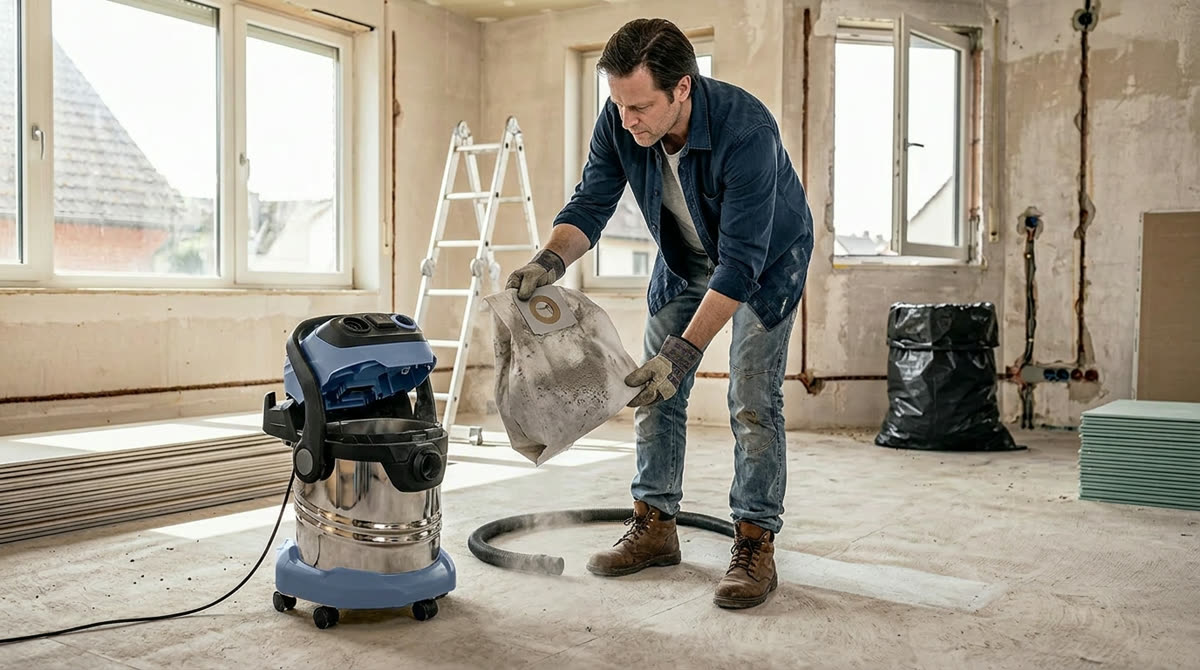
You're 20 minutes into sanding drywall mud. The vac that was screaming when you flipped it on is now wheezing like it's about to quit. Suction's gone. There's a fine white haze hanging in the room — coming out of the vac, not going in. You pop the top, and the pleated filter is caked solid.
Every drywall, remodel, and concrete guy knows this moment. Here's what's actually happening, and how to stop it for good.
Why drywall dust clogs a shop vac so fast
Drywall dust isn't like sawdust. It's gypsum ground into a powder finer than flour — particles small enough to slip straight through the pleats of a standard wet/dry vac filter and pack into them like wet cement.
A shop vac moves air by pulling it through that pleated filter. The second the pleats load up with fine dust:
- Airflow drops, so suction craters
- The motor has to work harder to pull air that isn't moving
- The dust that doesn't stick blows back out the exhaust — into your lungs and all over the room you just cleaned
So it's not that your vac is weak. It's that fine dust is choking the one part that has to breathe.
Drywall and concrete dust also carry respirable crystalline silica on a lot of jobs — the stuff OSHA regulates because it wrecks lungs. A vac that's blowing fine dust back into the air isn't just annoying. It's a health problem.
The fixes contractors try (and where each one falls short)
1. Bang the filter out / blow it with compressed air. Works for about ten minutes. You're knocking loose the surface dust, but the fine stuff is packed into the pleats and never fully comes out. You're also standing in a cloud of silica every time you do it. Short-term band-aid.
2. Disposable filter bags. A real improvement — the bag catches the bulk before it hits the filter. But fine drywall dust still works through, the bags fill fast on a finishing crew (often one every day or two), and at $8–$10 a bag you're now paying a running subscription to slow the problem down, not solve it. Run the numbers over a year and it stings — we did the math in the real cost of disposable bags.
3. A cyclone / dust separator. A pre-separator pulls the heavy stuff into a bucket before the vac. Genuinely good for chips and coarse debris. But for fine drywall dust, plenty still carries over into the vac, you've added a second can to haul around the site, and it's another $40–$100+ of gear to buy and move.
Each of these is fighting the same losing battle: dust and airflow are sharing the same path, so the filter always takes the hit eventually.
The actual fix: separate the dust from the airflow
The reason filters die is that the dust and the air go through the same place. Fix that, and the filter stops clogging.
That's the whole idea behind a reusable Muk Buddy bag. The two-chamber design keeps the dust load away from the airflow path, so the pleated filter behind it doesn't get hammered with fine gypsum. The result on a drywall job:
- Suction holds instead of fading after 20 minutes
- The filter stays clear, so it lasts years instead of months
- The motor gets the airflow it needs, so it isn't running hot and dying early
- Less dust blowing back into the room — and your lungs
And because it's reusable, you buy it once. No bag to reorder every week, no filter to replace every quarter.
What to do on your next dusty job
If you're cleaning up drywall, concrete, or demo dust:
- Always run a bag — bagless straight onto the filter is the fastest way to kill it
- Use a bag that separates dust from airflow, not just one that catches the bulk
- Stop blowing out clogged filters with compressed air in an enclosed space — that's silica in the air you're breathing
- Match the bag to your vac — most reusable bags fit standard 2.5" wet/dry vac inlets (RIDGID, Stanley, Craftsman, Shop-Vac, Vacmaster and the rest)
Clogging on drywall dust isn't a sign you need a stronger vac. It's a sign the dust is reaching the filter. Keep it off the filter and the vac you already own runs like it's supposed to.
Tired of fighting it? See how Muk Buddy works — one reusable bag, no more clogged filters, no more reorders.